skip to main content

Crushing on idioms

APA Style leaf logo Cite This Webpage in APA Style
Greenbaum, H. (2026, February 13). Crushing on idioms. APA Style. https://apastyle.apa.org/blog/idioms

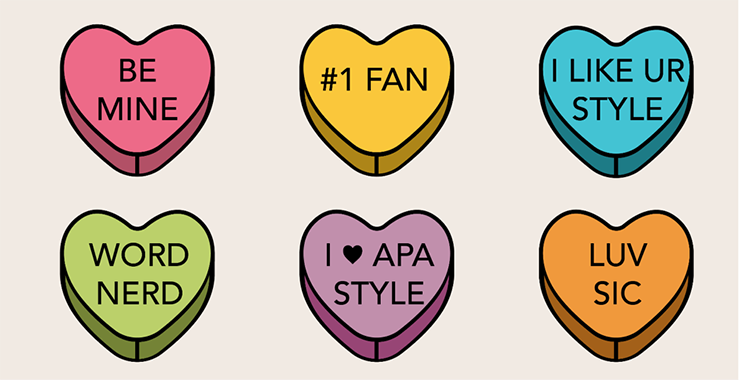
Illustration of colored hearts with the text BE MINE, WORD NERD, #1 FAN, I LOVE APA STYLE, I LIKE UR STYLE, LUV SIC

Happy Valentine’s Day from the APA Style team!

Idioms are also known as “figures of speech” or “expressions.” These phrases are commonly used in a culture that have an agreed-upon meaning that is not literal.

In English-speaking countries, some common romantic idioms are:

Be my valentine

Love at first sight

The apple of my eye

Wear your heart on your sleeve

Catch feelings

In research articles, idioms are rare except in titles or perhaps in introductions. Authors may use idioms to capture attention or to add creativity to their scholarly writing. Idioms may also appear elsewhere in an article, such as when authors intentionally reproduce language used with study participants. In other forms of writing, such as blog posts, informal language and idioms are used more frequently throughout the text. When writing research articles, make sure your tone remains formal and objective, and avoid overusing idioms. The blog post “Check your tone: A blog post on keeping it professional” covers the concept of tone more thoroughly. Additionally, it is important to keep your audience in mind as common phrases are often culturally specific. And, as always, use bias-free language—be sure to avoid idioms that contain offensive or insensitive wording.

Idioms do not usually need to be cited because they are considered common knowledge, meaning knowledge that is widely known and not attributed to a specific source. Common knowledge does not need to be cited and includes sayings, proverbs, idioms, and widely recognized expressions.

When using an idiom, just incorporate it into the title or sentence without doing anything else special. You do not need to format it with italics or quotation marks. For example, the following article titles contain idioms:

Loves Me, Loves Me Not: Perceived Romantic Partner’s Ambivalence Is Associated With Lower Personal and Relationship Well-Being

Catching Feelings: Exploring Commitment (Un)Readiness in Emerging Adulthood

You’re the Apple of My Eye: An Interdisciplinary Science Exploration for Young Children

References for these published articles are in the list at the end of this post. Note how the authors did not format or cite the common phrases they used.

However, use quotation marks around “loves me, loves me not,” “catching feelings,” or “you’re the apple of my eye” when using it as a linguistic example, as I just did. This guideline is from Sections 6.7 and 4.7 of the seventh editions of the Publication Manual of the American Psychological Association (APA, 2020b) and the Concise Guide to APA Style (APA, 2020a). This might happen, for example, when discussing the history or meaning of the idiom. Citations may be appropriate—if you want to credit a source that discusses or explains the phrase (such as a book, an article, or a website), cite that source, creating a reference based on the format of the source. For example, if I wanted to discuss the idiom “head over heels,” I could cite the definition from the Merriam-Webster Dictionary as follows:

Being “head over heels” in love with someone means the love is so deep that it is like being metaphorically upside down (Merriam-Webster, n.d.).

In short, feel free as a bird to use idioms in your writing—just don’t go overboard, especially in scholarly work. You generally do not need to format idioms with quotation marks, italics, or any other special indicator unless you are discussing the idiom itself as a linguistic example. For more information on how to cite dictionary-related references, review Section 10.3 of the seventh editions of the Publication Manual (APA, 2020b) and the Concise Guide (APA, 2020a).

What are some of your favorite idioms? Have you ever used idioms in your APA Style writing? Comment below. Have a LOVEly day!

References

American Psychological Association. (2020a). Concise guide to APA Style (7th ed.). https://doi.org/10.1037/0000173-000

American Psychological Association. (2020b). Publication manual of the American Psychological Association (7th ed.). https://doi.org/10.1037/0000165-000

Đurić, M., Righetti, F., Zoppolat, G., Solleiro Saura, C., & Schneider, I. K. (2025). Loves me, loves me not: Perceived romantic partner’s ambivalence is associated with lower personal and relationship well-being. Emotion, 25(5), 1225–1243. https://doi.org/10.1037/emo0001493

Hauser, B. (1998). You’re the apple of my eye: An interdisciplinary science exploration for young children. Bulletin of Science, Technology & Society, 18(4), 285–288. https://doi.org/10.1177/027046769801800408opens in new window

LeFebvre, L. E., & Carmack, H. J. (2020). Catching feelings: Exploring commitment (un)readiness in emerging adulthood. Journal of Social and Personal Relationships, 37(1), 143–162. https://doi.org/10.1177/0265407519857472opens in new window

Merriam-Webster. (n.d.). Head over heels. In Merriam-Webster.com dictionary. Retrieved January 26, 2026, from https://www.merriam-webster.com/dictionary/head%20over%20heelsopens in new window


Comments are disabled due to your privacy settings. To re-enable, please adjust your cookie preferences.