
skip to main content

Publication Manual and other style products

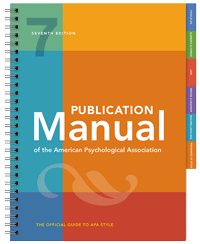
Publication Manual of the American Psychological Association, Seventh Edition

Known for its authoritative, easy-to-use reference and citation system, the Publication Manual also offers guidance on choosing the headings, tables, figures, language, and tone that will result in powerful, concise, and elegant scholarly communication.

Concise Guide to APA Style, Seventh Edition

Designed for undergraduate writers or anyone new to APA Style, this easy-to-use pocket guide is adapted from the seventh edition of the Publication Manual of the American Psychological Association.

Mastering APA Style Student Workbook, Seventh Edition

The official interactive guide to learning APA Style, this all-digital workbook engages users online with applied questions and summative quizzes to learn and master the basic principles of APA Style and scholarly writing.
Style and grammar guidelines

Style and Grammar Guidelines

APA Style guidelines encourage writers to fully disclose essential information and allow readers to dispense with minor distractions, such as inconsistencies or omissions in punctuation, capitalization, reference citations, and presentation of statistics.

Abbreviations

An abbreviation is a shortened form of a word or phrase; abbreviations of phrases are often composed of the first letter of each word of the phrase (i.e., acronym). To maximize clarity, use abbreviations sparingly.

Bias-Free Language

Writers using APA Style must strive to use language that is free of bias and avoid perpetuating prejudicial beliefs or demeaning attitudes in their writing. Topics covered: age, disability, gender, participation in research, race and ethnicity, sexual orientation, socioeconomic status, and intersectionality.

Capitalization

APA Style is a “down” style, meaning that words are lowercase unless there is specific guidance to capitalize them.

Grammar

The grammar and usage guidelines in the Publication Manual represent only the most common areas of concern for writers—verbs, pronouns, and sentence construction.

In-Text Citations

APA Style provides guidelines to help writers determine the appropriate level of citation and how to avoid plagiarism and self-plagiarism. We also provide specific guidance for in-text citations, including formats for interviews, classroom and intranet sources, and personal communications; in-text citations in general; and paraphrases and direct quotations.

Italics and Quotation Marks

Italics are used to draw attention to key terms and phrases when providing definitions and to format parts of reference list entries. Quotation marks are used to present linguistic examples and titles of book chapters and articles in the text.

Lists

Lists help readers understand a related set of key points within a sentence or paragraph; ensure all items are syntactically and conceptually parallel.

Numbers

Writers may report numerical information about participants (number of participants, demographic information such as age, etc.) as well as the results of statistical analyses. Even writers who are not conducting empirical research often use statistical information to support key points.

Paper Format

Consistency in the order, structure, and format of a paper allows readers to focus on a paper’s content rather than its presentation. To format a paper in APA Style, writers can typically use the default settings and automatic formatting tools of their word-processing program or make only minor adjustments.

Punctuation

Punctuation establishes the cadence of a sentence, telling readers where to pause (comma, semicolon, and colon), stop (period and question mark), or take a detour (dash, parentheses, and square brackets).

References

References provide the information necessary for readers to identify and retrieve each work cited in the text. Consistency in reference formatting allows readers to focus on the content of your reference list, discerning both the types of works you consulted and the important reference elements with ease.

Research and Publication

The guidelines on these pages help authors navigate the research and publication process, including determining what information to include in their research report, preparing a manuscript for submission to a journal, and communicating with editors and reviewers during peer review.

Spelling and Hyphenation

Guidelines for spelling and hyphenation ensure that writers use consistent spellings for terms within and across works. In general, spelling and hyphenation should match the spellings given in either the Merriam-Webster.com Dictionary or the APA Dictionary of Psychology.

Tables and Figures

Tables and figures enable writers to present a large amount of information efficiently and to make their data more comprehensible. APA Style guidelines for tables and figures help ensure that visual displays are formatted clearly and consistently, thus contributing to the goal of effective communication.

Seventh Edition blog

APA Style Blog

Style experts from the American Psychological Association share tips and background about writing in APA Style.

Instructional aids

Instructional Aids

Handouts, guides, and sample papers, all of which can be printed, downloaded, and used while writing your papers.

APA Style just for you

APA Style for Beginners

This page is your gateway to getting started with APA Style, the writing style that helps you communicate clearly, precisely, and inclusively.

APA Style for Nurses

This page helps nursing students, educators, and professionals find nursing-specific content for APA Style.

APA Style for Teachers

Educators, the resources on this page will help you teach your students how to write with clarity, precision, and inclusion.
Last updated: October 2026Date created: 2019

7th Edition Publication Manual

7th Edition of the Publication Manual book cover
Buy Now
Available in multiple formats