Appendices contain information that supplements the text but would be distracting or inappropriate to include in the text itself. Appendices are not required but can be included in both student and professional papers. The number of appendices in a paper will vary depending on the needs of the work.
Appendices most often consist of text, tables, or figures, or a combination of these. Many kinds of materials are suitable for an appendix, including the following:
- lists of stimulus materials
- instructions to participants
- tests, scales, or inventories developed for the study being reported
- handouts or educational materials
- detailed descriptions of complex equipment, procedures, or subpopulations in the study
- other detailed or complex reporting related to fulfillment of APA Style journal article reporting standards (APA Style JARS)
Use the guidance on this page for
- basic appendix format that applies to all appendices
- appendices consisting of only one table or figure
- appendices consisting of multiple tables and/or figures
- appendices consisting of a combination of text, tables, and/or figures
Learn more
Appendices are covered in the seventh edition APA Style manuals in the Publication Manual Section 2.14 and the Concise Guide Section 1.14

Basic appendix format
The following example shows the basic format of an APA Style appendix. This appendix contains a scale developed for the study being reported.

To set up an APA Style appendix, begin each appendix on a separate page at the end of the paper.
Write the appendix label at the top of the page in bold and centered.
- When there is only one appendix, use the label “Appendix.”
- When there are multiple appendices, use the label “Appendix” plus a capital letter (e.g., “Appendix A,” “Appendix B”).
Write the appendix title on the next line after the appendix label in bold and centered. Ensure the title describes the content of the appendix.
After the appendix label and title, present the content of your appendix. Double-space all text, and ensure any citations in the appendix appear in the main reference list for the paper.
Ensure page numbers appear on every page of the paper in the top right corner, including all pages of an appendix.
Refer to or call out each appendix in the text of the paper.
- To call out an appendix, mention what readers will find in the appendix, for example, “The Appendix contains the items of the Relationship Description Scale.”
- Call out parts of an appendix in the text if desired, for example, “Table C3 contains the parameters for the multilevel model” (Table C3 would appear within Appendix C).
- If the paper contains multiple appendices, call them out in the text in the order in which the appendices appear (i.e., call out Appendix A first, then Appendix B, etc.).
To learn more about appendices, check out these examples:
- The example of multiple appendices (DOCX, 2MB)opens in new window shows the format of appendices in a word-processing environment.
- The design project student paper template (DOCX, 2MB)opens in new window shows a full paper with appendices, including images reproduced from other sources and appendix callouts in the text.
Appendices consisting of only one table or figure
An appendix may consist of only one table or figure. In this case, the appendix label takes the place of the table or figure number, and the appendix title takes the place of the table or figure title (see the section about basic appendix format for more about these elements).
The following example shows an appendix consisting of one figure.
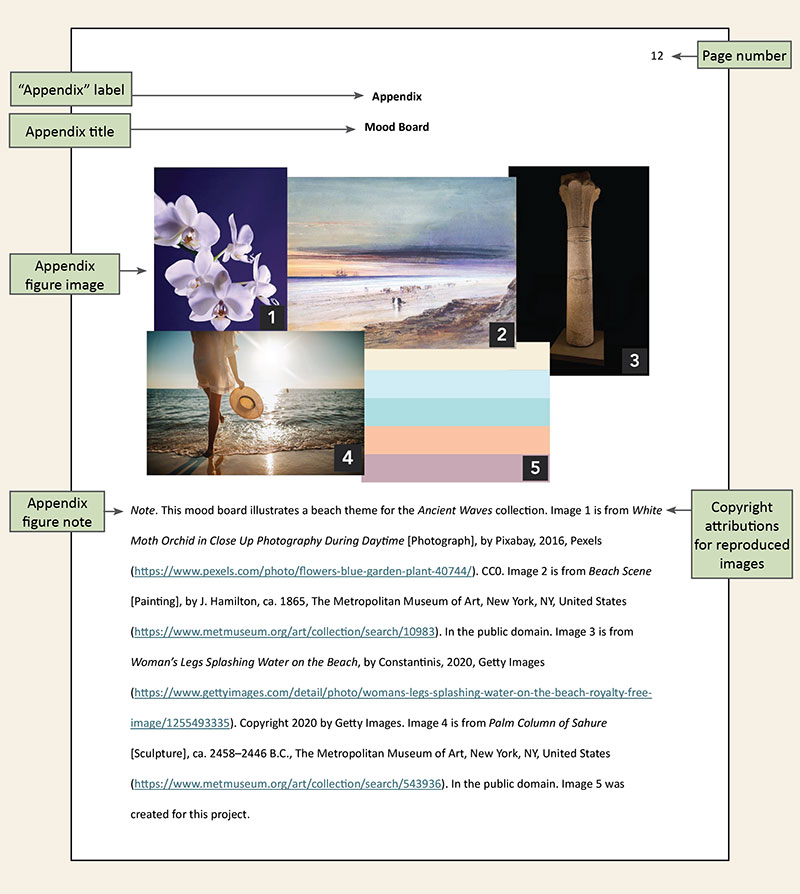
This figure is a mood board in which multiple images are combined to create one figure. Because some of the images are reproduced from other sources, the images require copyright attributions in the figure note (see the Clip Art and Stock Images page for more).
Appendices consisting of multiple tables and/or figures
Present multiple related tables and/or figures within one appendix if desired. In this case, write the appendix label and title on separate lines in bold and centered, as described in the section about basic appendix format, and present tables and figures as you would in the text (see the Table Setup and Figure Setup pages for more).
Add the letter of the appendix before the table or figure number to distinguish it from any tables or figures in the main text (e.g., Figure B1 appears in Appendix B). Use the letter “A” before the table or figure number if the paper has only one appendix, as in the following example of a single appendix consisting of Figures A1 and A2. Do not use a period in between table or figure letters and numbers (i.e., “Figure A1,” not “Figure A.1”).
The following example shows multiple related figures presented as one appendix.

Note that the images within these figures do not require copyright attributions because the author purchased licenses to reproduce them without attribution (see the Clip Art and Stock Images page for more).
Appendices consisting of text as well as tables and/or figures
Appendices can consist of text along with tables and/or figures. In this case, write the appendix label and title on separate lines in bold and centered, as described in the section about basic appendix format, and present tables and figures as you would in the text (see the Table Setup and Figure Setup pages for more).
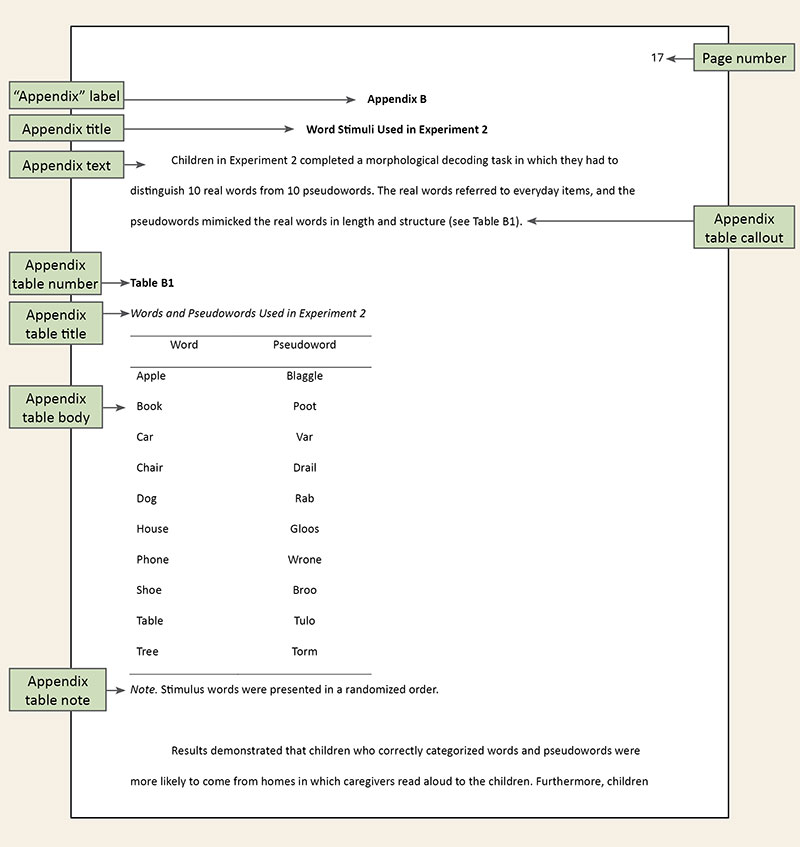
Ensure you call out the appendix tables or figures within the text of the appendix so that readers know what to look for.
The following example appendix includes text and a table. The appendix table is called out in the appendix text before it is presented.